Seven Factors That Drive Job Satisfaction
New Gallup data show employees value belonging, support and growth more than compensation. Here's what the data show and leaders need to know.
If you're spending $500K annually on safety programs for a workforce that already feels safe, while ignoring belonging initiatives that would have 1.5x the satisfaction impact, you're not only leaving money on the table but also actively misallocating it.
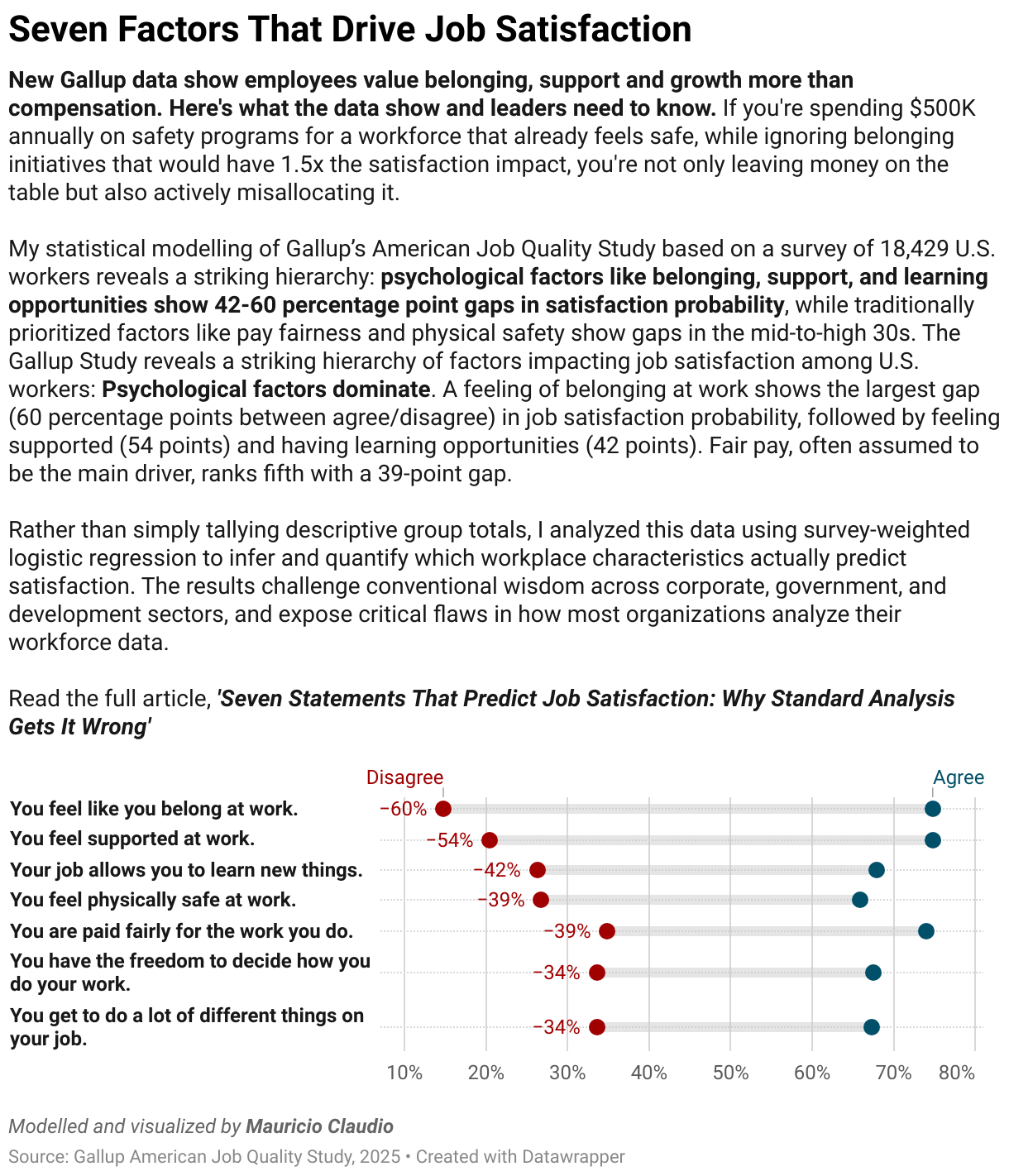
My statistical modelling of Gallup’s American Job Quality Study based on a survey of 18,429 U.S. workers reveals a striking hierarchy: psychological factors like belonging, support, and learning opportunities show 42-60 percentage point gaps in satisfaction probability, while traditionally prioritized factors like pay fairness and physical safety show gaps in the mid-to-high 30s. The Gallup Study reveals a striking hierarchy of factors impacting job satisfaction among U.S. workers: Psychological factors dominate. A feeling of belonging at work shows the largest gap (60 percentage points between agree/disagree) in job satisfaction probability, followed by feeling supported (54 points) and having learning opportunities (42 points). Fair pay, often assumed to be the main driver, ranks fifth with a 39-point gap.
Rather than simply tallying descriptive group totals, I analyzed this data using survey-weighted logistic regression to infer and quantify which workplace characteristics actually predict satisfaction. The results challenge conventional wisdom across corporate, government, and development sectors, and expose critical flaws in how most organizations analyze their workforce data.
Read the full article, 'Seven Statements That Predict Job Satisfaction: Why Standard Analysis Gets It Wrong'